Tuesday, September 29, 2015

Re-discovery of Deudorix staudingeri (The Large Cornelian)

Deudorix staudingeri (The Large Cornelian)

In year 2012, Gan CW, a senior member of Nature Society Singapore Butterfly Group photographed a larger than usual Cornelian looks alike butterfly. It was then identified as Cornelian (Deudorix epijarbas) but Gan noted it was larger then the usual Cornelian.

Until recently, with the help of Dr. TL Seow (a Malaysian butterfly expert), the butterfly then identified as The Deudorix staudingeri (The Large Cornelian).


Butterfly Description
The species is rare, known only from Singapore, P. Malaysia, Borneo and Nias (Indonesia). The Large Cornelian (D. staudingeri) may be confused with the commoner Cornelian (D. epijarbas), but on average it is larger. The male is deeper red  on upperside. On underside the white striae are poor, sullied whitish and fading, the dark striae are more prominent than in D. epijarbasAlways  with diffuse dark post-fiscal spots on hindwing.

Deudorix staudingeri (The Large Cornelian) - Photo by Gan CW


Photo of the Cornelian (Deudorix epijarbas) for comparison.
Deudorix epijarbas (Cornelian) - Photo by Jit Leang Foo
Special thanks:
  • Dr. TL Seow for his help in identifying the butterfly
  • Gan CW for sharing his finding
  • Jit-Leang Foo for allowing his photo to be share in the blog
  • Fellow NSS Butterfly Group member who participated in the discussion

References:
  • The Butterflies of The Malay Peninsula, A.S. Corbet and H.M. Pendlebury, 4th Edition, Malayan Nature Society.


Monday, September 28, 2015

The White Club Flitter (Hyarotis microsticta) - A Skipper New to Singapore!

Another butterfly new to Singapore!

Hyarotis microsticta (The White Club Flitter) - Photo by Yik Shih


Recently NSS member Yong Yik Shih, photographed a dark brown skipper at Ubin, and request NSS Butterfly Group to assist on the ID. The group can't decide on it and seeks advice from Dr. TL Seow - a Malaysian butterfly expert.

According to Dr. TL Seow, the skipper photographed by Yik Shih, is a female Hyarotis microsticta (The White Club Flitter), and the photographs is sufficient to ID the species with confidence!


Butterfly Description
The species are described as rare in P. Malaysia. The wings are dark brown, forewing of the species has small white hyaline spots at end-cell, space 2 and 3 and the usual sub-apical series, semi-hyaline spot may present at space 1b.


ID key for the species:
Wings span: 32 - 38 mm
Forewing with 3 sub-apical spots; Forewing cell spot narrow.
Hindwing with dark blotches & few white dots.
Antennal club bears a white patch before the apiculus

Hyarotis microsticta (The White Club Flitter) - Photo by Yik Shih

Hyarotis microsticta (The White Club Flitter) - Photo by Yik Shih

The White Club Flitter, photographed on 2007 at Sungei Buloh Wetland Reserve

Hyarotis microsticta (The White Club Flitter) - Photo by Soon Chye

Hyarotis microsticta (The White Club Flitter) - Photo by Soon Chye


Special thanks:
Dr. TL Seow
Dr. Kalesh
Yong Yik Shih for allowing her photo to be share in the blog
Fellow NSS butterfly group member who participated in the discussion


References:
  • The Butterflies of The Malay Peninsula, A.S. Corbet and H.M. Pendlebury, 4th Edition, Malayan Nature Society.
  • Butterflies of Thailand, Pisuth Ek-Amnuay, 1st Edition, 2006


Sunday, September 27, 2015

A Skipper New to Singapore - Potanthus ganda

Potanthus ganda (The Ganda Dart)

With the used of Butterfly Photo ID website ("skipper edition"), there's a new species of skipper being highlighted from old photo archive, it's also a species that not recorded by early author in Singapore - Potanthus ganda.

A male specimen was collected recently, after much scrutiny to the voucher specimen, it's now confirmed that the species is indeed a Potanthus ganda.


Butterfly Description:
Wingspan: 21 - 24 mm
A small species, looks very similar to the more common Lesser Dart (P. omaha).
The Ganda Dart differs from Lesser Dart in that the veins on the yellow band on hindwing above are not blacked. Upperside forewing spots in spaces 4 & 5 narrow separated from sub-apical spots. The species ascends the hills, and restricted to forested area.


An old photo of  Potanthus ganda, previously ID as Potanthus omaha (Lesser Dart).


Quick ID key to identify Potanthus ganda:


Photo showing the underside of P. ganda


Photo showing the male genitalia of Potanthus ganda. Note the uncus ends in a very broad & shallow "V" shape. Small drawing on the bottom left show the illustration in C&P4 for this species of butterfly.


References:
  • The Butterflies of The Malay Peninsula, A.S. Corbet and H.M. Pendlebury, 4th Edition, Malayan Nature Society.
  • Butterflies of Thailand, Pisuth Ek-Amnuay, 1st Edition, 2006


Wednesday, September 23, 2015

Early stage of Yellow Flat

Yellow Flat (Mooreana trichoneura trichoneura)


Butterfly Description:
Wingspan: 32-36 mm

Yellow Flat is rare in Singapore and not recorded by early author, and described as rare even in Malaysia. The adults of the species are found at one particular location at Singapore but believed to also found at the Western Catchment area.

The adult skipper preferred shady area and only venture to sunny spots for egg laying and sunbathing.


Host plant Description:
Family: Euphorbiaceae
Mallotus paniculatus (Turn-in-the-wind)

The host plant Mallotus paniculatus is shrubs and can grows up to 15 meter tall, with alternate leaves, tripli-veined. The leaf attract ants to feed on the nectary gland found at upper leaf base.

Host Plant with flower

Host plant: Mallotus paniculatus

The leaf with shelters of Yellow Flat caterpillar

Early stages Description:
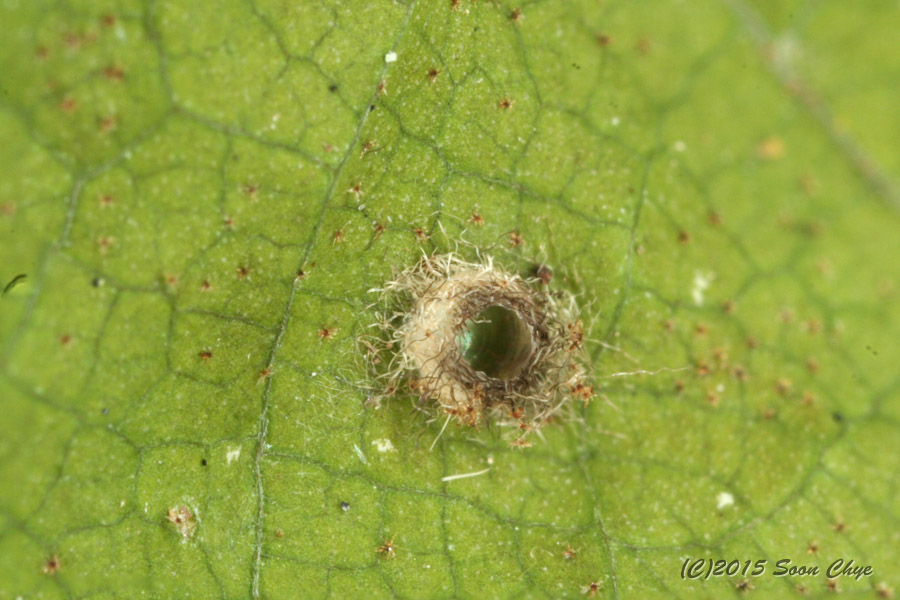
Eggs of Yellow Flat are laid singly on the host plant leaf surface & concealed with hair from the female abdomen, usually not more than 1 egg found on a single leaf. Egg hatched after 5~7 days, only the top portion consumed by the caterpillar as shown below. The entire early stage from egg to adult took about 50 - 64 days to complete.


Egg of Yellow Flat (5-7 days to hatch)

Close-up view of the egg

Empty egg shell, only the top portion consumed by the larva


1st instar (5-6 days) - orange colour with reddish brown stripe at the side.

The 1st instar larva at the edge of the leaf, only slightly thicker than the leaf


2nd instar larva (5-6 days)

Leaf  shelter of the 2nd instar larva


2 views of the 3rd instar larva (6-8 days)


Early 4th instar larva (6-10 days)

Late 4th instar larva


5th instar larva in defence mode (15 days)

head view of 5th instar larva

5th instar larva

Leaf shelter of 5th instar larva with special feeding mark

Larva in pre-pupation stage (1.5 days)

Pupa of Yellow Flat


front view of the pupae


The pupae took 9 day to hatch into a beautiful Yellow Flat


References:
  • The Butterflies of The Malay Peninsula, A.S. Corbet and H.M. Pendlebury, 4th Edition, Malayan Nature Society.
  • The Life Histories of Asian Butterflies Vol 2, Igarashi S & Fukuda H

Wednesday, September 9, 2015

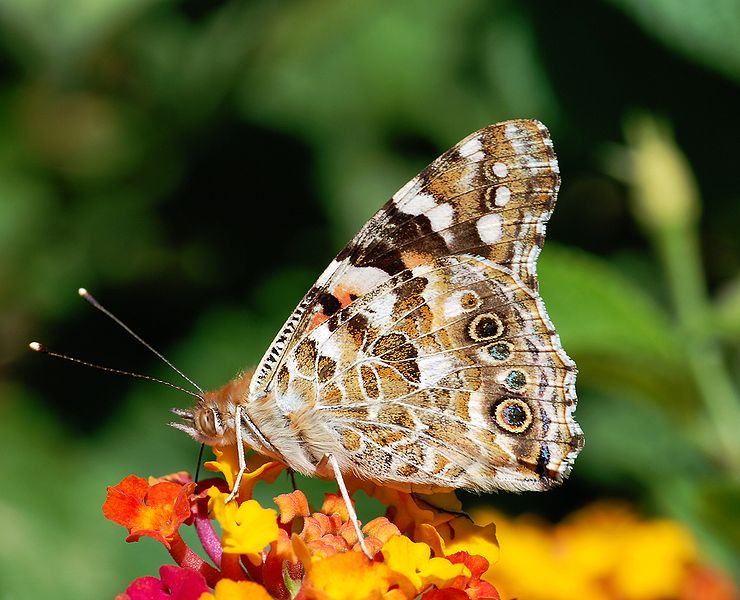
Reappearence of Painted Lady butterfly in Singapore

On 7 Sep 2015, a Painted Lady Butterfly (Vanessa cardui) was sighted again since the last sighting in 2007 by fellow member of Butterfly of Singapore and malaysia group.

This time, it was sighted near to the location where the species first found - near the Bukit Panjang Nursery, by member of Butterflies of Singapore and  Malaysia group - Cerlin Ng.

Photo by Cerlin Ng
Photo by Cerlin Ng
To clarify the doubt of many, this is not an American visitor and not American specific butterfly, calling it American visitor is misleading. In the actual fact, the butterfly species can be found all over the world on every continent except Antarctica and South America.

Photo by Alvesgaspar

Similar to the previous encounters, they are found in very pristine condition, thus casting doubt on the theory that the butterfly migrated from elsewhere (e.g. Malaysia, India or even America??). Even in Malaysia, this butterfly is rare and have not been seen for years. It was mentioned in the Popular Butterfly Book (Butterfly of Malay Peninsular) that it is a highland species and common at Cameron Highlands.
One theory is that it could be brought in together with the many plants imported from Malaysia especially Cameron Highland, hatched in nursery, and further depart from the nursery to other location in Singapore.

Further reading:
Wikipedia - describing the distribution, migration and other info.

Migration of the Painted Lady to North Africa to southern Europe.


Friday, August 14, 2015

OpenCV, Deep Learning & Butterfly

How does the computer terms link to butterfly?

Let's take a look at the definition at Wikipedia:
OpenCV (Open Source Computer Vision): https://en.wikipedia.org/wiki/OpenCV

Now, it come to a time that we (human), can leverage on computer power, to assist in Animal Identification.

How does it work?
We are leveraging on Computer Vision technology, to analyse photo of butterfly, and compare it against our database, and leveraging on the Deep Learning technology, the program would then provide best match of the butterfly.

In a layman term, we train the computer to recognise objects and computer can do it much better than us. In the actual fact, we are using the technology everyday without realising it -- most of the newer mobile camera now come with the Face Recognition function, behind the scene, it is using the same technology.

What's next?
We are releasing a platform to allow people to submit photo of butterfly and the computer will try to identify the butterfly, and learn at the same time.


Butterfly Id Project - coming soon...

Sunday, September 28, 2014

Detached Dart (Potanthus trachala)

The species in the genus Potanthus, are not easy to identify in the field. The easiest way to identify a P. trachala is to observed the upperside forewing, where the spots in spaces 4 and 5, are out of line with the spots below.

The species is quite common in Singapore and not rare in Peninsula Malaysia, and can be found at all usual elevations, in both primary and secondary forest. Range from India to China and Sundaland.


Set specimen of T. trachala


Male valva of P. trachala (Note; uncus tapering to a blunt triangular point)


Overview of the male valva of Potanthus sp. from "The Butterflies of the Malay Peninsula"